Your water heater heats cold water all day long. As water heats up, it expands. That extra volume has to go somewhere. In older homes with open plumbing systems, it pushed back toward the main supply line without issue. In modern homes with closed systems, it cannot and that trapped pressure builds up fast.
If you have ever wondered what is an expansion tank and whether your home needs one, the short answer is this: it is a small safety device that protects your water heater, pipes, and fixtures from pressure damage. Most homes built after 2005 require one by code.
What Is an Expansion Tank?
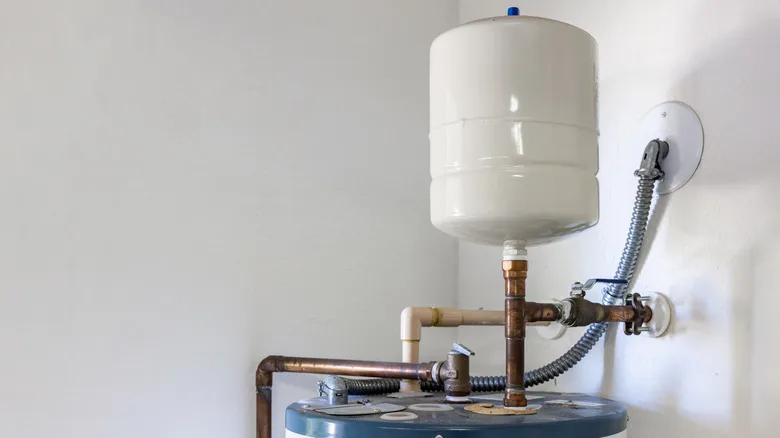
An expansion tank is a small pressurized vessel connected to your water heater’s cold water supply line. It gives expanding hot water a safe place to go when pressure builds inside a closed plumbing system.
The tank itself is about the size of a basketball for most residential installations. Inside, a rubber diaphragm divides the tank into two chambers:
- The water side: Accepts the expanding water from your plumbing system.
- The air side: Pre-charged with air or nitrogen at a set pressure, usually matching your home’s water pressure (typically 50 to 80 PSI).
When water in your heater heats up and expands, the extra volume pushes into the expansion tank. The diaphragm compresses the air cushion to make room. When you open a faucet and pressure drops, the air cushion pushes the water back into the system.
This back-and-forth happens silently dozens of times a day. You never notice it and that is exactly the point.
Why Thermal Expansion Is an Issue
Water expands when it heats up. This is basic physics. A 50-gallon water heater holding water at 120°F contains about 0.5 gallons more volume than the same tank filled with cold water. That extra half-gallon needs somewhere to go.
In an open plumbing system (no check valve or backflow preventer on the main supply line), that extra water simply pushes back into the municipal supply. No pressure buildup. No problem.
In a closed plumbing system which most homes have today a check valve or pressure reducing valve (PRV) on the main line blocks that reverse flow. The expanding water is trapped inside your home’s pipes with nowhere to go.
The result is a condition called thermal expansion pressure. Here is what that does over time:
Damages your water heater. The pressure relief valve (T&P valve) on your heater is designed to open at 150 PSI. If thermal expansion regularly pushes pressure toward that limit, the valve cycles open and close repeatedly. It wears out, starts leaking, or fails sometimes catastrophically.
Wears out fixtures and valves. Faucets, toilet fill valves, and washing machine hoses are not rated for repeated pressure spikes. Constant thermal expansion stress shortens their lifespan significantly.
Causes pipe stress. Pressure spikes travel through every pipe in your home. Over years, this contributes to pinhole leaks, joint failures, and water damage.
Voids your water heater warranty. Most manufacturers require an expansion tank on closed systems. Installing a water heater without one on a closed system can void the warranty immediately.
The hot water expansion tank purpose is simple: absorb that thermal expansion before it causes any of the above damage.
How Expansion Tanks Work
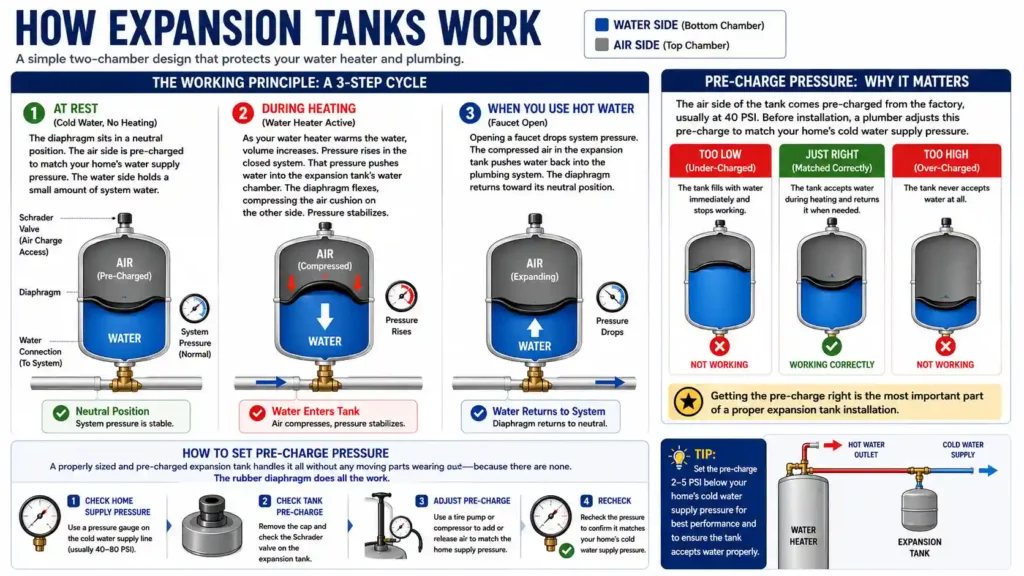
The working principle is straightforward once you understand the two-chamber design.
At rest (cold water, no heating): The diaphragm sits in a neutral position. The air side is pre-charged to match your home’s water supply pressure. The water side holds a small amount of system water.
During heating (water heater active): As your water heater warms the water, volume increases. Pressure rises in the closed system. That pressure pushes water through the cold supply line into the expansion tank’s water chamber. The diaphragm flexes, compressing the air cushion on the other side. Pressure in the system stabilizes.
When you use hot water: Opening a faucet drops system pressure. The compressed air in the expansion tank pushes water back into the plumbing system. The diaphragm returns toward its neutral position.
This cycle repeats every time your water heater fires. A properly sized and pre-charged expansion tank handles it all without any moving parts wearing out because there are none. The rubber diaphragm does all the work.
Pre-Charge Pressure: Why It Matters
The air side of the tank comes pre-charged from the factory, usually at 40 PSI. Before installation, a plumber adjusts this pre-charge to match your home’s cold water supply pressure. If the pre-charge is too low, the tank fills with water immediately and stops working. If it is too high, the tank never accepts water at all.
Getting the pre-charge right is the most important part of a proper expansion tank installation. It requires a pressure gauge on the cold water supply line and a tire pump or compressor on the tank’s Schrader valve (the same type as a bicycle tire valve).
You can read about: Do dishwashers heat the water?
Do You Need an Expansion Tank in Your Home?
Not every home needs one. But many do and local plumbing codes in most U.S. cities now require them on closed systems.
You likely need an expansion tank if:
- Your home has a pressure reducing valve (PRV) on the main water supply line
- Your home has a check valve or backflow preventer installed by your water utility
- You have a tankless water heater on a closed system (yes, tankless units need them too)
- Your local building code requires one (check with your city most jurisdictions adopted this requirement after 2002)
- Your T&P relief valve drips regularly (a common sign of thermal expansion pressure)
- Your water pressure gauge shows spikes above 80 PSI
You likely do not need one if:
- Your home has a true open plumbing system with no check valve or PRV
- Your water utility confirmed no backflow preventer on your meter
The fastest way to know for certain: have a licensed plumber test your system pressure and check whether you have a closed system. This takes about 15 minutes and removes all guesswork.
What Happens If You Skip It?
Skipping a hot water expansion tank on a closed system is a false economy. The $60 to $200 tank cost looks attractive to skip until you are replacing a failed T&P valve ($150), a burst water heater ($800 to $1,500), or repairing water damage from a blown pipe fitting ($2,000 to $10,000+). Every licensed plumber will tell you the same thing: the expansion tank is cheap insurance.
Types of Expansion Tanks
Not all expansion tanks are the same. Knowing the types helps you understand what your plumber installs and why.
Potable Water Expansion Tanks (Thermal Expansion Tanks)
These are the most common type in residential homes. They connect directly to the cold water supply line feeding your water heater. They are NSF-61 certified, meaning the materials are safe for contact with drinking water. Brands like Amtrol (WH-series), Watts, and Rheem make reliable potable water expansion tanks.
Typical sizes: 2 to 4.5 gallons for most residential water heaters.
Hydronic Expansion Tanks
These are used in closed-loop heating systems, boilers, radiant floor heating, and some HVAC systems. They are not certified for potable water contact and should never be used on a domestic water heater. They look similar but serve a different system.
Bladder vs. Diaphragm Tanks
Both use a flexible barrier to separate water from air. A diaphragm tank has the membrane bonded to the shell. A bladder tank has a removable balloon-style bladder. For residential water heater applications, diaphragm-style tanks are the standard.
You can read about: What Causes Heat Exchanger to Crack
Choosing the Right Size of Expansion Tank
Size matters. An undersized tank fills up completely and stops absorbing pressure. An oversized tank costs more and takes up unnecessary space.
Sizing depends on three factors:
- Water heater capacity (in gallons)
- System water pressure (measured at the cold supply line)
- Water heater temperature setting (typically 120°F to 140°F)
Here is a general sizing guide for residential systems:
| Water Heater Size | System Pressure | Expansion Tank Size |
| 40 – 50 gallons | 40 – 60 PSI | 2 gallon |
| 40 – 50 gallons | 60 – 80 PSI | 3.2 gallon |
| 80 gallons | 40 – 60 PSI | 3.2 gallon |
| 80 gallons | 60 – 80 PSI | 4.5 gallon |
| Tankless (any size) | 40 – 80 PSI | 2 – 4.5 gallon |
When in doubt, size up. A slightly larger tank handles pressure more comfortably and lasts longer than one running at its maximum capacity every heating cycle.
Your plumber will calculate the exact size using a formula that accounts for your specific heater capacity, inlet temperature, outlet temperature, and system pressure. Do not guess on this an incorrectly sized tank will not protect your system.
Expansion Tank Installation: What to Expect
Installing a hot water expansion tank is a straightforward job for a licensed plumber. For a homeowner without plumbing experience, it is not a recommended DIY project mainly because of the pre-charge pressure matching step and the need to work on a pressurized water system.
What the installation involves:
- Shut off the cold water supply to the water heater
- Drain pressure from the system
- Check and record the home’s cold water supply pressure
- Adjust the expansion tank’s pre-charge to match that pressure
- Install a tee fitting on the cold water supply line near the water heater
- Connect the expansion tank to the tee using a threaded male adapter
- Mount the tank to the wall or a bracket (expansion tanks should never hang freely on the pipe the weight causes joint stress over time)
- Restore water pressure and check for leaks
- Verify the system pressure is stable after the water heater completes a full heating cycle
A licensed plumber typically completes this in under an hour. Cost runs $150 to $350 installed in most U.S. markets, including the tank and labor.
You can read about: Whole-House Water Filtration System Cost
Maintenance Tips
A properly installed expansion tank requires very little maintenance. But a few checks keep it working correctly for years.
Check the pre-charge pressure annually. Use a tire pressure gauge on the Schrader valve (with water pressure relieved from the system first). The reading should match your home’s cold water supply pressure. If the air pressure has dropped, add air with a hand pump. If it keeps losing pressure, the diaphragm may be worn and the tank needs replacement.
Check for waterlogging. Knock on the tank with your knuckles. A healthy tank sounds hollow on top (air side) and more solid on the bottom (water side). If the whole tank sounds solid, it is waterlogged — the diaphragm has failed and the tank is no longer doing its job. Replace it.
Watch your T&P valve. If your temperature and pressure relief valve on the water heater starts dripping, that is a sign the expansion tank may have failed or was never installed. Do not ignore a dripping T&P valve.
Replace every 5 to 10 years. The rubber diaphragm degrades over time. Most manufacturers recommend replacement every 5 to 10 years depending on water quality and usage. If your expansion tank is over 8 years old and you have never had it inspected, have a plumber check it on your next service visit.
Do not paint over the tank. Some homeowners paint expansion tanks to match the room. Paint traps moisture against the shell, causing rust. Leave the tank as-is.
Signs Your Expansion Tank Has Failed
Knowing what to watch for saves you from a bigger problem.
- T&P valve dripping or releasing water regularly — the tank is not absorbing pressure
- Banging or knocking in pipes — water hammer from pressure spikes
- Pressure gauge readings spiking above 80 PSI — thermal expansion going unchecked
- Tank feels completely full and heavy — waterlogged diaphragm
- Visible rust or corrosion on the tank shell — exterior moisture damage
- Water heater making popping or rumbling sounds — pressure cycling stress
Any of these signs warrants a call to a licensed plumber. Catching a failed expansion tank early is far less expensive than dealing with a failed water heater or burst pipe.
Contact Derks Plumbing
If you are in the Los Angeles area and are not sure whether your home has an expansion tank or whether yours is still working correctly Derks Plumbing can check your system and give you a straight answer.
We offer professional Plumbing Services in Los Angeles including expansion tank installation, water heater service, and full plumbing inspections. Our licensed plumbers check your system pressure, confirm whether you have a closed system, and install the right size expansion tank for your water heater. No upselling, no guesswork.
Contact Derks Plumbing to schedule a visit or ask a question about your home’s plumbing system.

Conclusion
So what is an expansion tank in plain terms? It is a small pressurized vessel that protects your entire plumbing system from thermal expansion pressure. It absorbs the extra water volume created every time your water heater heats up. Without it, that pressure cycles through your pipes, fixtures, and water heater every single day wearing everything out faster than it should.
Most homes with closed plumbing systems need one. Most local codes now require one. And at $150 to $350 installed, it is one of the least expensive ways to protect a $1,000+ water heater and your home’s plumbing system overall.
FAQs
What is an expansion tank used for?
An expansion tank absorbs the extra water volume created when your water heater heats water. It prevents thermal expansion from causing pressure spikes that damage your water heater, pipes, and fixtures.
Is an expansion tank required by code?
In most U.S. cities, yes. Any home with a closed plumbing system meaning a pressure reducing valve or check valve on the main supply line is required to have a thermal expansion tank on the water heater. Check with your local building department for your specific jurisdiction.
What is the hot water expansion tank?
The hot water expansion tank purpose is to give expanding heated water a safe place to go in a closed plumbing system. Without it, pressure builds until the T&P relief valve opens or a fitting fails.
How long does an expansion tank last?
Most residential expansion tanks last 5 to 10 years depending on water quality, usage frequency, and installation quality. Annual pre-charge checks extend their lifespan. Any tank over 8 years old should be inspected.
How do I know if my expansion tank has failed?
The most common signs are: a dripping T&P relief valve on the water heater, a tank that feels completely solid and heavy (waterlogged), pressure spikes above 80 PSI, or water hammer sounds in the pipes.
Can I install an expansion tank myself?
Technically yes, but it is not recommended without plumbing experience. The critical step matching the tank’s air pre-charge to your home’s water supply pressure requires a pressure gauge and accurate measurement. An improperly pre-charged tank will not protect your system even if physically installed correctly.
What size expansion tank do I need?
Size depends on your water heater capacity, system water pressure, and temperature setting. A 2-gallon tank handles most 40 to 50-gallon heaters at 40 to 60 PSI. Higher pressure systems or larger heaters need 3.2 to 4.5 gallons. Have a licensed plumber calculate the exact size for your system.
What is the difference between an expansion tank and a pressure tank?
An expansion tank (thermal expansion tank) is used specifically on domestic hot water systems to absorb thermal expansion. A pressure tank is used on well water systems to maintain consistent water pressure throughout the home. They look similar but serve completely different functions and are not interchangeable.




