You turned on the shower, started the dishwasher, and someone in the kitchen opened the hot tap and suddenly the water coming out of your showerhead felt like a cold drizzle. Sound familiar?If you own a tankless water heater and you’re frustrated with inconsistent or weak hot water flow, you’re not imagining it. The problem is real, and it comes down to one thing: GPM gallons per minute. Understanding how a tankless water heater pumps more GPM (and what limits it in the first place) can save you from unnecessary upgrades, wasted money, and daily frustration.
At Derks Plumbing, we’ve seen this issue come up again and again with homeowners across Eagle Rock and the surrounding areas. This guide is built on real field experience not generic manufacturer talking points to help you understand exactly what’s happening inside your system and what you can actually do about it.
What Determines GPM in a Tankless Water Heater?
GPM gallons per minute is the measure of how much hot water your tankless heater can deliver continuously at any given moment. Unlike a traditional tank heater that stores pre-heated water, a tankless unit heats water on demand, which means the flow rate is directly tied to its heating capacity.
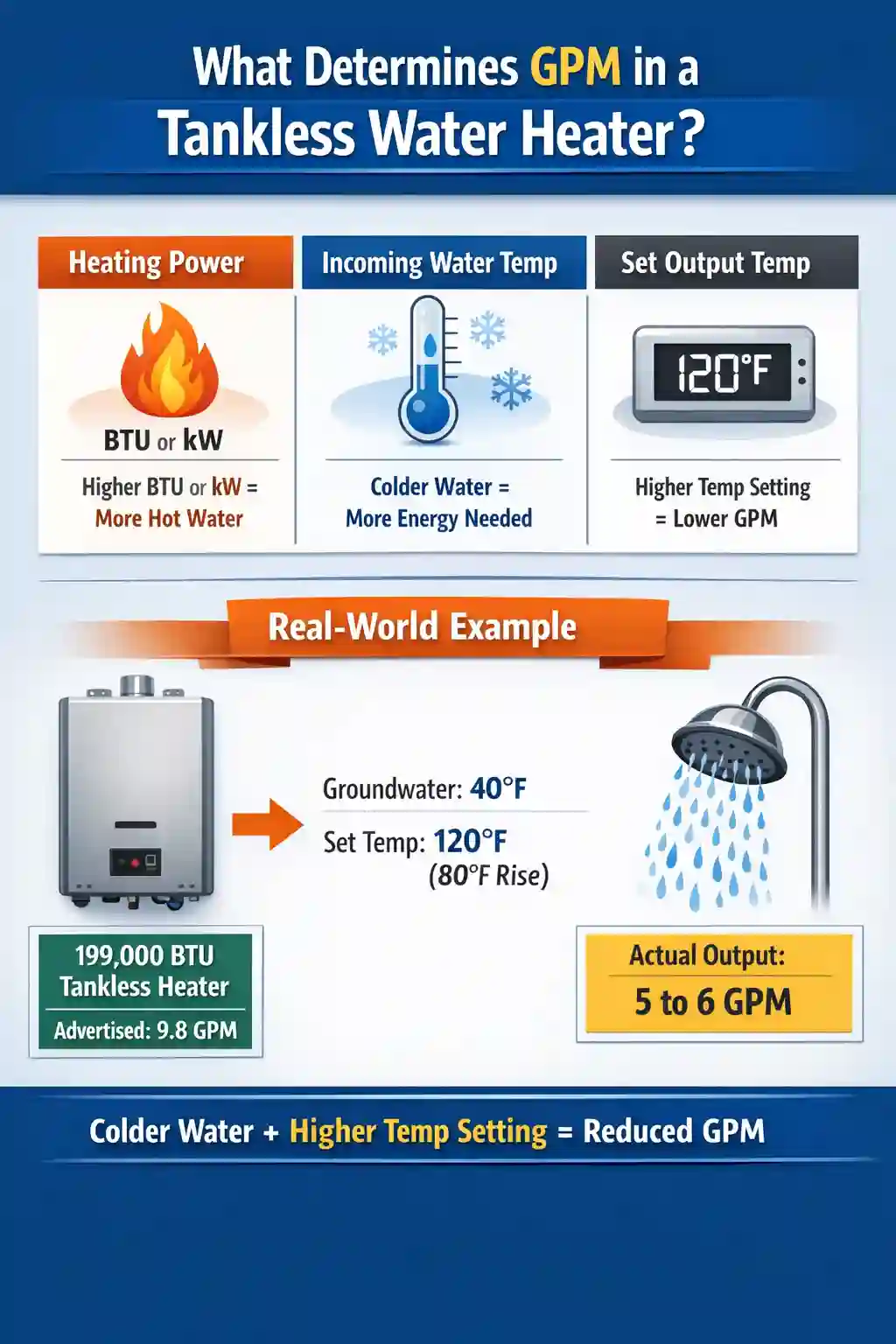
Three core factors control this:
- BTU output (gas units) or kW rating (electric units) — The more heating power the unit has, the more water it can heat per minute.
- Incoming water temperature — Cold groundwater takes more energy to heat than warm water.
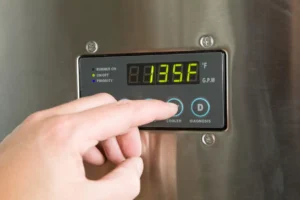
- Set output temperature — The higher your target temperature, the fewer gallons the unit can heat per minute.
Here’s a real-world example: A 199,000 BTU gas tankless heater might advertise 9.8 GPM on the box. But that number assumes a 35°F temperature rise. If you’re in a colder climate where groundwater comes in at 40°F and you want 120°F output, you’re asking for an 80°F rise and that same unit may only deliver 5 to 6 GPM reliably.
Understanding Temperature Rise
Temperature rise is probably the most overlooked factor when homeowners ask how many GPM a tankless water heater needs to handle their household.
Temperature Rise = Desired Output Temp − Incoming Water Temp
In warmer southern states, groundwater might come in at 68°F to 72°F. In northern states and high-altitude areas, that same pipe might deliver water at 40°F to 45°F. The difference matters enormously.
Here’s a simple breakdown:
| Incoming Water Temp | Desired Output | Temperature Rise | Approximate GPM (200K BTU unit) |
| 70°F | 120°F | 50°F | ~7.5 GPM |
| 55°F | 120°F | 65°F | ~5.8 GPM |
| 40°F | 120°F | 80°F | ~4.7 GPM |
So before asking how can a tankless water heater pump more GPM, you first need to know what temperature rise you’re actually dealing with. This one number changes everything.
How Many GPM Do You Actually Need?
Most households underestimate their simultaneous hot water demand. Here’s what typical fixtures use:
- Shower: 1.5 – 2.5 GPM
- Kitchen faucet: 1.0 – 1.5 GPM
- Dishwasher: 1.0 – 1.5 GPM
- Washing machine: 1.5 – 2.0 GPM
- Bathroom faucet: 0.5 – 1.0 GPM
So if you’re running a shower and the kitchen sink at the same time, you need roughly 3 to 4 GPM of true hot water output not the peak rating printed on the spec sheet.When thinking about how many GPM for a tankless water heater, the practical rule is:
Calculate your peak simultaneous demand, then add 20–25% as a buffer.
A family of four with two bathrooms typically needs 6 to 9 GPM of reliable output, factoring in temperature rise. Many homeowners buy a unit rated at 8 GPM but get confused when they only see 5 GPM in actual use. Now you know why.
Why Does My Flow Rate Drop?
This is the question we hear constantly on service calls. Your unit worked fine for a year, and now the hot water seems weaker. Here’s what’s usually happening:
- Mineral Scale Buildup Hard water deposits calcium and magnesium inside the heat exchanger over time. This acts like insulation between the burner and the water, reducing heat transfer efficiency which means the unit has to slow flow to compensate.
- Partially Blocked Inlet Filter Tankless heaters have a small mesh filter at the cold water inlet. If yours hasn’t been cleaned in 12+ months, it may be restricting flow before water even reaches the heating element.
- Undersized Gas Line This one surprises people. A gas tankless unit running at full capacity needs a properly sized gas supply line. If the line is too small, the unit can’t reach full BTU output — especially when demand spikes.
- Venting Restrictions Improper or partially blocked venting on gas units can cause the unit to throttle down as a safety measure.
- Cold Weather Drop Winter hits and groundwater gets colder. Your unit isn’t broken, it’s just working harder for the same output.
How Can a Tankless Water Heater Pump More GPM?
Now we get to the practical part. Here are the most effective, real-world methods to increase your tankless water heater’s GPM output.
1. Lower Your Set Temperature (Strategically)
Set your tankless heater to 120°F and install a mixing valve at point-of-use fixtures. Why? Because the heater produces more GPM at lower output temps. A mixing valve then blends cold water in at the fixture to reach your comfort temperature. You get more volume from the heater without sacrificing comfort.
2. Descale the Heat Exchanger Annually
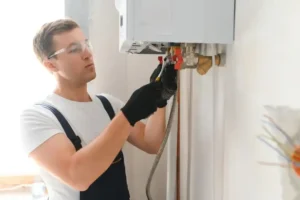
Flushing your tankless unit with a descaling solution (white vinegar or a commercial descaler) removes mineral buildup and restores heat transfer efficiency. Most manufacturers recommend this every 12 months in hard water areas. It’s the single most impactful maintenance task you can do, and it often restores lost GPM without any hardware changes.
3. Clean or Replace the Inlet Filter
It takes five minutes. Turn off the water supply, unscrew the inlet filter screen, rinse it under running water, and reinstall. You’d be surprised how often this alone fixes a “low flow” complaint.
4. Upgrade Your Gas Line
If you’ve verified that your unit is undersized relative to your actual GPM needs, sometimes the fix isn’t a new unit, it’s a properly sized gas supply. A 3/4-inch gas line instead of a 1/2-inch line can allow your existing unit to fire at full capacity consistently.
5. Install a Recirculation Pump
A recirculation pump doesn’t technically increase GPM output but it eliminates the “cold water sandwich” effect (that frustrating burst of cold water before hot arrives) and reduces the time you spend waiting, which in practice means you’re using hot water more efficiently.
6. Add a Second Unit or Go Parallel
For larger homes with genuinely high simultaneous demand, two smaller tankless units running in parallel is often more effective and more energy-efficient than one oversized unit. This also provides redundancy: if one unit needs service, you still have hot water.
7. Upgrade to a Higher-Capacity Unit
Sometimes the honest answer is that the existing unit is simply underpowered for your home’s needs. If you’re asking how many GPM water heater do I need and the math says you need 8 GPM but your unit maxes out at 5 GPM on a cold day, no amount of maintenance will solve the gap.
You can read about: How to Replace a Tankless Water Heater
When a Tankless Heater Cannot Pump More GPM
There are scenarios where the limitation is physical and not fixable without replacement:
- Electric tankless units in cold climates have hard limits; they often can’t overcome a 70°F+ temperature rise at meaningful flow rates without massive electrical upgrades.
- Units that are significantly undersized relative to household demand will always underperform regardless of maintenance.
- Old units (10+ years) with worn heat exchangers may have degraded too far for descaling to restore performance.
In these cases, the right move is a professional assessment not guesswork.
Common Mistakes Homeowners Make
Buying based on the peak GPM rating alone. Always calculate your temperature rise scenario first, then find the GPM at that rise in the unit’s spec sheet.
Skipping annual maintenance. A tankless heater is not “set it and forget it.” Annual descaling in hard water areas is essential.
Ignoring gas line sizing. Installing a high-capacity unit on an undersized gas supply is like putting a sports engine in a car with a garden hose for a fuel line.
Expecting one unit to serve a large home in cold climates. A single 9 GPM unit in Minnesota in January may only deliver 5 GPM at your needed temperature rise. Parallel systems exist for a reason.
Conclusion
Getting more GPM from your tankless water heater is less about throwing money at new equipment and more about understanding the system you already have. Start with your temperature rise, check your maintenance history, verify your gas supply, and then make a data-driven decision not one based on frustration.
Whether it’s a simple descaling job or a full system upgrade, the right answer starts with an honest assessment. Contact Derks Plumbing today to schedule a professional evaluation. Our team specializes in Tankless Water Heater Installation in Eagle Rock and can help you determine exactly what your home needs and nothing it doesn’t.

Frequently Asked Questions
Q: How many GPM does a tankless water heater actually need to serve a family of four?
Most families of four with two bathrooms need between 6 and 9 GPM of reliable output, accounting for simultaneous use and temperature rise. The specific number depends on your climate and how many fixtures run at the same time. Always calculate your real peak demand before buying.
Q: Can I increase my tankless heater’s GPM without replacing the unit?
Yes in many cases. Descaling the heat exchanger, cleaning the inlet filter, lowering your set temperature with mixing valves, and ensuring your gas line is properly sized can all restore or increase effective GPM without buying a new unit.
Q: Why does my tankless water heater perform worse in winter?
Colder incoming groundwater means a higher temperature rise is required to reach your desired output temperature. This reduces the GPM your unit can deliver. It’s not a malfunction, it’s physics. In cold climates, size your unit for winter conditions, not summer averages.
Q: How many GPM for a tankless water heater do I need if I’m just replacing an old tank heater?
Start by listing every hot water fixture in your home and its GPM draw. Add up the fixtures you realistically run at the same time. Factor in your incoming water temperature and desired output. Add a 20–25% buffer. That total is your minimum GPM requirement.
Q: Is it better to install two smaller tankless units or one large one?
For larger homes or high-demand households, two units in parallel often makes more practical sense. You get built-in redundancy, easier installation in some homes, and more flexible zoning. One large unit is simpler to manage but creates a single point of failure and may require significant gas line upgrades.